Mù Xiāng (木香), known in English as Costus root (Aucklandia lappa), is a warm, acrid and bitter Chinese herb from the Regulate qi category. It enters the Spleen, Stomach, Large Intestine and Gallbladder channels. Its main action: moves qi, relieves pain — especially Middle and Lower Jiao.
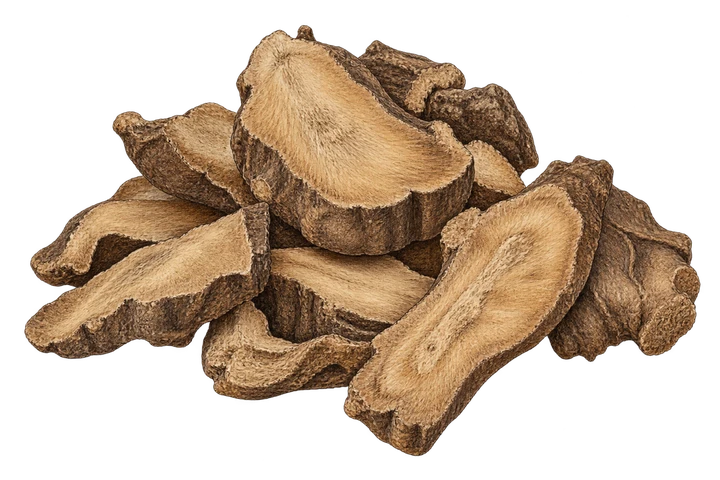
| Pinyin | Mù Xiāng (Mu Xiang) |
|---|---|
| Chinese | 木香 |
| English | Costus root |
| Botanical name | Aucklandia lappa |
| Category | Regulate qi |
| Nature | Warm |
| Flavour | Acrid, Bitter |
| Channels | Spleen, Stomach, Large Intestine, Gallbladder |
| Dosage | 3–6g (add late for moving qi) |
| Cautions | Yin deficiency with Fire; Heat patterns |
Actions
- Moves qi, relieves pain — especially Middle and Lower Jiao
- Regulates Spleen, stops diarrhoea
Indications
- Qi stagnation with epigastric/abdominal pain
- Diarrhoea with tenesmus
- Liver/GB qi stagnation
How to remember Mù Xiāng
Regulate qi herbs are mostly warm or hot, acrid and bitter, and most enter the Spleen and Stomach channels.
- You can work these out
- Warm, Acrid, Bitter, Stomach channel: like most Regulate qi herbs
- Spleen channel: from its action “Regulates Spleen”
- Large Intestine channel: from its action “stops diarrhoea”
- Learn by heart
- Gallbladder channel: nothing in its group or its actions points to it
Formulas containing Mù Xiāng
Other Regulate qi herbs
- Chén Pí
- Zhǐ Shí
- Xiāng Fù
- Chén Xiāng
- Qīng Pí
- Fó Shǒu
- Chuān Liàn Zǐ
- Lì Zhī Hé
- Dà Fù Pí
- Wū Yào
- Zhǐ Ké
- Jú Hóng
- Xiè Bái
- Tán Xiāng
- Méi Guī Huā
Test yourself
What is the nature and flavour of Mù Xiāng?
Mù Xiāng is warm and acrid and bitter.
Which channels does Mù Xiāng enter?
Mù Xiāng enters the Spleen, Stomach, Large Intestine and Gallbladder channels.
What are the actions of Mù Xiāng?
Moves qi, relieves pain — especially Middle and Lower Jiao; Regulates Spleen, stops diarrhoea.
What is Mù Xiāng used for?
Qi stagnation with epigastric/abdominal pain; diarrhoea with tenesmus; Liver/GB qi stagnation.
Which formulas contain Mù Xiāng?
Guī Pí Tāng, Sháo Yào Tāng and Juān Bì Tāng.
Practise Mù Xiāng and the other 290 herbs
Recognise each herb from its picture, recall its nature, flavour, channels and actions, and review it again just before you would forget it.
Try the 5-question herb quizShen Study is a study tool. Doses and cautions are as taught in standard Chinese materia medica texts; they are not prescribing advice.