Every Chinese Medicine student knows the feeling. You can list the actions of Huang Qi. You can describe the spleen functions from memory. But when a patient walks in with fatigue, loose stools and a pale complexion, your mind goes quiet.
That gap — between knowing facts and knowing what to do with them — is the clinical reasoning gap. And it is the single most important skill that classroom study does not directly teach.
What clinical reasoning means in TCM
Clinical reasoning in Chinese Medicine is the process of moving from presenting signs and symptoms to a coherent pattern diagnosis, treatment principle and prescription. It involves:
- Pattern recognition — identifying which constellation of signs points toward Liver Qi stagnation versus Liver Fire, or Spleen Qi deficiency versus Spleen Yang deficiency.
- Differential diagnosis — distinguishing between TCM patterns that share similar features. For example, both Damp-Heat and Spleen Qi deficiency can present with fatigue and loose stools, but the treatment approaches differ significantly.
- Treatment logic — connecting pattern to principle and principle to prescription. Why choose Xiao Yao San over Chai Hu Shu Gan San when both address Liver Qi constraint?
- Point and formula selection — choosing acupuncture points and herbal formulas that match the diagnosis, and articulating the rationale behind each choice.
These are not skills that develop from reading alone. They require repeated, deliberate practice with realistic clinical material.
The problem with passive study
Highlighting textbooks and rewriting notes builds familiarity with material, but it does not build clinical decision-making. When you read a case in a textbook, the diagnosis is usually given at the end. You do not have to work through the uncertainty yourself.
In clinic, there is no answer key. The presentation is not neatly categorised. Tongue and pulse findings may point in different directions. The patient may have multiple overlapping patterns. Learning to reason through this ambiguity is what separates prepared students from those who feel lost when they enter the clinic.
How structured practice builds reasoning
Research in medical education consistently shows that deliberate practice with clinical cases accelerates diagnostic accuracy more than additional hours of passive study. The principle applies equally to Chinese Medicine education.
When you work through a case systematically — identifying patterns, selecting points, choosing formulas, and then receiving structured feedback — you build several cognitive skills at once:
- Pattern recognition speed improves as you encounter varied presentations of the same pattern.
- Differential analysis becomes sharper when you see why one pattern fits better than another.
- Prescription logic strengthens when you connect your treatment choices back to the pattern diagnosis and see what the model answer includes.
Over time, this repeated exposure trains a clinical instinct that textbook reading alone cannot provide. You begin to see patterns in presentations, not just isolated facts.
Beyond right and wrong
One of the challenges in learning clinical reasoning is that many clinical questions do not have a single correct answer. There may be several reasonable treatment approaches depending on the practitioner's lineage, the patient's constitution and the presenting context.
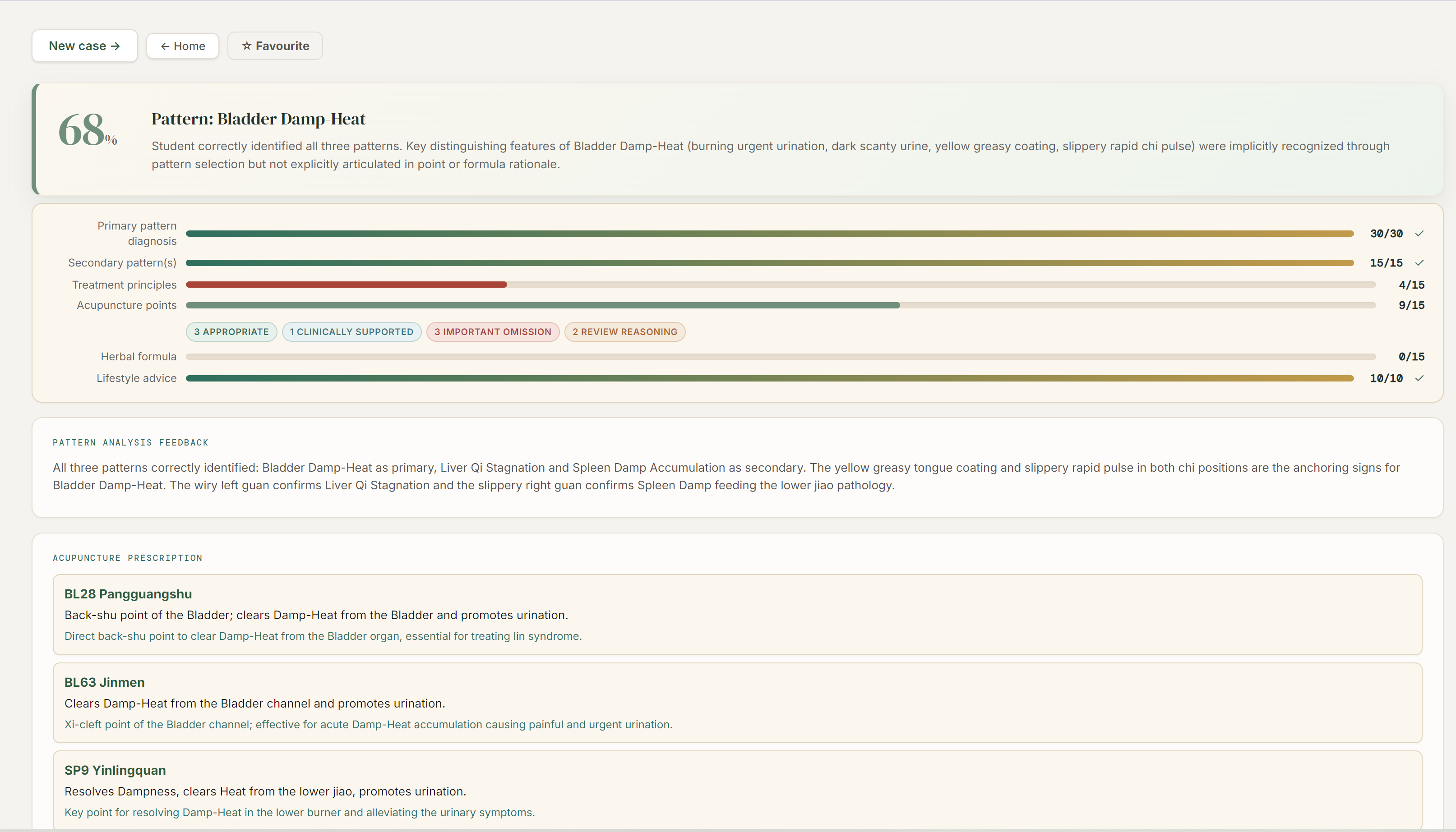
Good case practice tools acknowledge this. Instead of simple right-or-wrong marking, they separate model matches from clinically supported alternatives, and they indicate when a choice needs further review. This mirrors the reality of clinical decision-making more accurately than a binary score ever could.
Building the habit before clinic
TCM programs often introduce clinical placements in the later years, but clinical reasoning can and should be practised earlier. Structured case practice during the preclinical years builds a foundation that makes clinical placements far more valuable. Students arrive having already practised the basic reasoning loop — presentation, pattern, principle, prescription — and can focus on the subtleties that only real patient contact can teach.
Whether you are in your first year of TCM study or preparing for board exams, clinical reasoning practice is the most effective way to turn your knowledge into clinical competence.
Key takeaway
Clinical reasoning is the bridge between knowing and doing. Build it through repeated, deliberate case practice with structured feedback, not through passive reading alone.
Start practising clinical reasoning
Shen Study generates realistic TCM cases with structured feedback that teaches the reasoning behind every diagnosis and prescription choice.
Try a case free