One of the most common questions TCM students ask is: how do I prepare for the jump from classroom to clinic? The answer, consistently, is case practice.
Case study practice is the closest you can get to clinical experience without being in a clinic. It presents you with a patient scenario, asks you to work through the diagnostic and treatment process, and then gives you feedback on your reasoning. It is the bridge between theoretical knowledge and clinical application.
Why case practice matters
TCM board exams increasingly test clinical reasoning, not just factual recall. They present case scenarios and ask candidates to identify patterns, select treatments and justify their choices. The same skills are needed in clinical placements, where supervisors expect students to contribute to the diagnostic process, not just observe.
Case practice builds several skills simultaneously:
- Pattern recognition: Seeing the configuration of signs rather than isolated symptoms
- Differential diagnosis: Distinguishing between patterns that share overlapping presentations
- Treatment planning: Selecting appropriate acupuncture points and formulas based on the pattern
- Clinical reasoning: Articulating the logic behind each diagnostic and treatment decision
What makes a good TCM case study
Not all case studies are equally useful for learning. The most effective case studies for exam and clinic preparation share several features:
- Realistic presentation: The symptoms, history and context should reflect what a real patient might present with, not a textbook-perfect example
- Tongue and pulse findings: These are essential diagnostic data in TCM and should always be included
- Multiple choice options that test discrimination: The options should include patterns that could reasonably be confused with the correct answer, forcing you to work through the differential
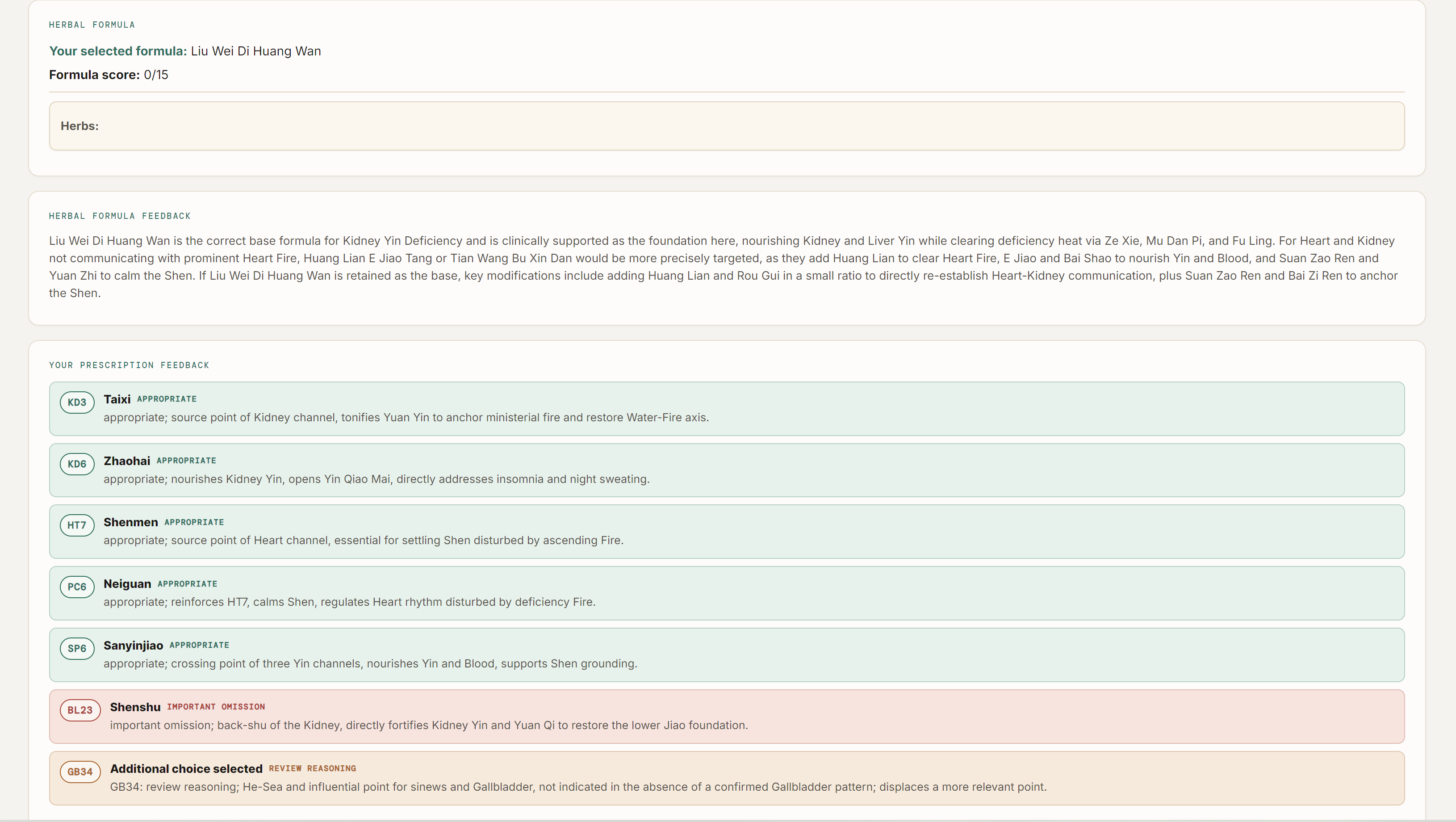
- Structured feedback: A good case study explains not just what the correct answer is, but why it is correct and why the alternatives are less supported
How to work through a case study effectively
1. Read the presentation carefully
Do not jump to diagnosis. Read the full presentation, noting key signs and their pattern significance. Pay attention to details that might seem minor — the quality of pain, the timing of symptoms, associated signs that point toward or away from specific patterns.
2. Form your diagnostic hypothesis
Before looking at answer options, ask yourself: what pattern or patterns fit this presentation? What is the strongest evidence for each candidate pattern? What evidence rules each out?
3. Consider the differential
If multiple patterns could fit, work through the differential systematically. For example: Liver Qi stagnation and Liver Fire share some features but differ in the presence of Heat signs, the nature of the pain, and the tongue and pulse findings.
4. Select the treatment
Based on your diagnosis, choose the treatment principle, the acupuncture points and the herbal formula. Ask yourself: does each choice follow logically from the pattern diagnosis?
5. Review the feedback carefully
When you receive feedback, pay attention to where your reasoning matched the model and where it diverged. Did you miss a key sign? Did you overweigh a less important finding? Did you correctly apply the treatment principle to the prescription?
This review step is where most of the learning happens. A case you get wrong and understand why is worth more than a case you get right by intuition.
Building a case practice routine
Consistency matters more than volume. A routine of one or two cases per week, worked through thoroughly with attention to the feedback, will build clinical reasoning more effectively than cramming many cases in a short period.
As exam season approaches, increase the frequency. Practise against the clock if your exam is timed. Use the same reasoning steps each time so the process becomes automatic.
For clinic preparation, focus on breadth. Practise cases across different organ systems and pattern types so you have encountered a wide range of presentations before you see real patients.
Feedback is the teacher
The quality of feedback is what separates useful case practice from simple self-testing. Good feedback does more than mark answers right or wrong. It identifies:
- Which parts of the diagnosis were clinically well supported
- Which important omissions were made
- Which choices were reasonable alternatives rather than errors
- What specific knowledge needs review
This kind of structured feedback turns every case into a learning opportunity, regardless of whether you got the answer right.
Key takeaway
TCM case study practice is the most effective way to build clinical reasoning for both exams and clinic. Work through cases consistently, focus on the feedback, and build a wide range of pattern recognition experience before you enter clinical practice.
Start practising with real TCM cases
Shen Study generates realistic clinical cases across multiple pattern categories with structured feedback that teaches the reasoning behind every diagnostic and treatment decision.
Start a free case