Chinese Medicine requires holding a large body of knowledge in memory: the actions of hundreds of herbs, the composition of dozens of formulas, acupuncture point locations and indications, pulse qualities, tongue signs, and pattern differentiation criteria. No single technique replaces the need for repetition, but spaced repetition makes that repetition far more efficient.
What is spaced repetition?
Spaced repetition is built around a simple observation: you learn more effectively when review sessions are spread out over time rather than compressed into a single session. A spaced repetition system (SRS) schedules each review at the point when you are about to forget the material.
Here is how it works in practice. You review a card. If you recall the answer correctly, the system waits longer before showing it again. If you struggle or get it wrong, it shows the card again sooner. Over time, cards you know well appear days or weeks apart. Cards you find difficult appear more frequently until the information sticks.
This means you spend less time on material you already know and more time on the areas that need reinforcement. The rhythm adjusts to your memory, not the other way around.
Why SRS fits TCM study well
TCM knowledge has characteristics that make spaced repetition particularly useful:
- Factual density. Herbs have actions, natures, flavours, meridian entries and dosages. Formulas have compositions, actions and modifications. Each fact is discrete and testable.
- Quick recall matters. In clinic and exams, you need to access information rapidly. SRS builds fast, reliable recall through repeated retrieval practice.
- Long retention is necessary. TCM knowledge must persist across years of study and into clinical practice. SRS is designed for long-term retention, not short-term cramming.
How to use SRS for herbs, formulas and points
These three areas are the most common candidates for a TCM SRS deck. Each works well with a front-and-back card format.
Herb actions and properties
Each herb has a nature (cold, cool, warm, hot), flavour (sour, bitter, sweet, acrid, salty), meridians entered, and primary actions. A typical card: front — "Bai Shao", back — "Nourishes Blood, preserves Yin, softens Liver, eases pain." Keep the information on the back concise. If an herb has many actions, make multiple cards rather than a single crowded one.
Formula composition
Knowing which herbs make up a formula and their roles (emperor, deputy, assistant, envoy) is essential for prescription logic. SRS helps you move from recognising formula names to recalling their full composition from memory. A useful variation is to show the list of herbs and ask for the formula name.
Acupuncture point locations and indications
Points have specific anatomical locations, meridian affiliations, and primary indications. Reviewing these regularly builds the quick recall you need during clinical practice. Some students add a second card for each point with a brief clinical scenario to reinforce when the point is chosen.
Using SRS for pattern recognition
Pattern differentiation is less about rote memorisation and more about recognising configurations of signs. Even so, SRS can help you build a reliable mental reference for each pattern.
A pattern card might look like this: front — "Key signs of Liver Qi stagnation", back — "Distending pain, sighing, mood irritability, wiry pulse, normal or slightly red tongue with thin coat."
For deeper learning, create contextual cards: "A patient presents with rib-side distension, frequent sighing and a wiry pulse. Which pattern is most likely?" This moves you from recognition to application, which is closer to what you will do in a case exercise or clinic.
Reviewing pattern cards alongside herb and formula cards creates natural cross-links in your memory. When you see Liver Qi stagnation in a pattern card and then review Xiao Yao San in a formula card, the two reinforce each other.
Using SRS to learn from case mistakes
One of the most effective uses of SRS in TCM study is reviewing the gaps that case practice reveals. When you work through a clinical case and get part of the diagnosis or treatment wrong, that specific gap is valuable information about where your knowledge needs strengthening.
Here is a practical workflow:
- Complete a case exercise and review the feedback.
- Identify the specific piece of knowledge that led to the mistake. Was it the pattern definition? A herb action you misremembered? A point indication you had not learned?
- Create a single SRS card targeting that specific gap. Keep it atomic and direct.
- Review that card in your normal SRS rotation. The context of the mistake makes the card more memorable than a generic review card.
This approach turns every mistake into a targeted study signal. Instead of vaguely feeling you need to "review patterns," you build a deck that reflects your actual weak points as revealed by case practice. Over time, the deck becomes personalised to the areas where you most need repetition.
Case mistakes are especially valuable for SRS because they carry context. A card created from a real mistake is more likely to stick than a card created from a textbook list, because your brain associates it with the effort of working through the case.
Pulse qualities and tongue signs
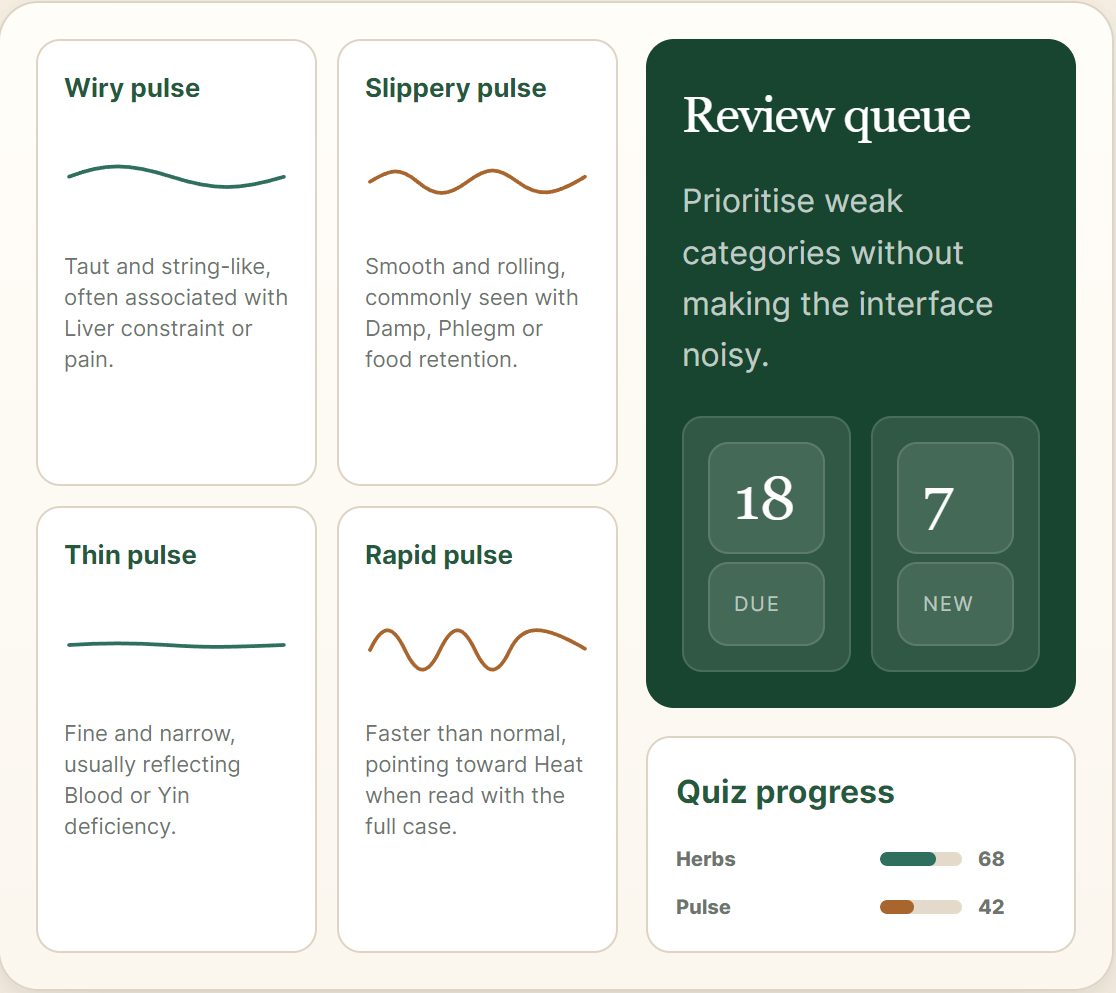
Pulse qualities like wiry, slippery, thin and rapid each have distinct tactile descriptions and clinical associations. Tongue body colours, coat qualities and shapes carry diagnostic meaning. These are well suited to descriptive flashcards that pair the quality name with its characteristics.
For pulse cards, include the sensation description and the clinical significance. For tongue cards, include the appearance and what it indicates. Both benefit from being reviewed in the same rotation as the patterns they help diagnose.
A practical study rhythm
Consistency matters more than volume. A daily review session of ten to fifteen minutes maintains your deck more effectively than a weekly hour-long session. Here is a simple rhythm that works for many TCM students:
- Daily — review your due SRS cards (herbs, formulas, points, patterns mixed together).
- Weekly — complete one or two case exercises. Note which cards the cases suggest you need.
- After each case — add two or three new cards based on mistakes or uncertain areas from the feedback.
This keeps your SRS deck alive and connected to your clinical reasoning practice. The deck is not a separate task. It is the memory layer of the same study process.
SRS as part of a broader approach
Spaced repetition is most effective when used alongside active methods like case-based practice. Flashcards build the factual foundation. Cases build the clinical reasoning that puts those facts to use.
When you encounter a herb or formula in a case and then review it in your SRS deck later, the two reinforce each other. The case gives context for the fact. The SRS review ensures the fact stays accessible.
Flashcards build the vocabulary. Cases teach you to speak the language.
Key takeaway
Spaced repetition helps you retain what you learn across herbs, formulas, points, patterns and pulse signs. Combined with case practice that reveals your knowledge gaps, it becomes a targeted tool for steady, practical progress.
Build your SRS study routine
Shen Study includes an SRS flashcard system across herbs, formulas, points, pulses, patterns and tongue signs, paired with clinical case practice that reveals where you need more review.
Start studying free